Monday, 13 March 2017

Bird watching the Yucatan (22nd Feb - 9th March ) day 1 cont.

After breakfast Angie joined me for another circuit of my temporary patch seeing many of the birds seen before breakfast but in addition picking up a kildeer (there were 3 on one of the empty plots) and a female magnolia warbler.

View of one of the roads I birded

Kildeer


Magnolia warbler

I also spent some time trying to decide whether I was seeing Tropical or Couch's Kingbird (or both) on the wires (it seems they were split in 1966). There are some minor differences in beak size (tropical has the largest)  and the fork in the tail (tropical most forked) but the easiest was to tell them apart is by call. However that requires you knowing the call and find them calling. Most were silent. In the end I resorted to videoing any that did call and checking against Xeno canto so I know I saw both.


Tropical Kingbird

Couch's Kingbird

As the day got warmer the vultures became more obvious and we saw 3 species - turkey (red head), black (black head) and lesser yellow headed vultures (yellow and blue head). None of the shots were good but they were good enough to be sure of the id.


Turkey Vulture

Lesser yellow-headed vulture

The two vulture shown have white rear halves of the wings so can be confusing at a distance, the black headed (didn't get a good shot till later in the holiday so not shown at this time) has white wing tips only.
It was soon getting too hot to continue so it was off to the pool for some serious studying of the inside of my eyelids and perhaps a beer or two.

My poolside patch

My relaxation didn't last too long as laughing gulls kept landing on the edge of the pool to have a drink and royal terns kept flying past temptingly. So back to the room for the camera - a 10 yard walk. How I suffer for my sport.

Laughing Gull

Royal tern

Whilst getting these shots I looked down to the beach - well hardly a beach as the waves were often lapping up against the concrete wall that supported the infinity pool. On the beach were now 4 species of wader:- turnstone, grey plover, sandling and a tiny wader (5 of) that I now know to be  least sandpiper.

The next hour or so was spent getting ridiculously close to these waders - often down to 5 yards. The only problem was the harsh light.

Sandling

Least sandpiper
Grey Plover

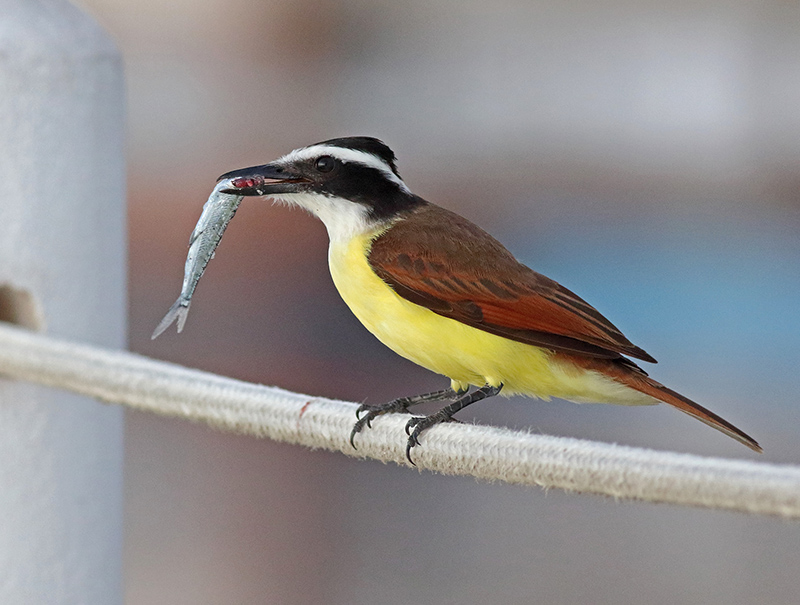
After the waders it was back to the sun bed only to be disturbed by the resident great kiskadee landing on the pool edge!


Late afternoon I did my circuit again adding collared dove, white winged dove and most surprising a black headed trogon.( I was later told the 2 local trogons aren't normally seen near the coast but the drought inland had driven them coast-wards.)

White-winged dove


Black-headed trogon (male)
That concluded my first days birding. Nothing spectacular but very pleasing for what was in reality a housing esate. I'd racked up 31 species and at no time been further than 200 yards from the hotel.


Sunday, 12 March 2017

Bird Watching in the Yucatan (22nd Feb - 9th March 2017)

My latest bird watching trip was to the Yucatan. As normal this was a general holiday with birding being conducted mainly before breakfast on or near the hotels we (my wife Angie and me) were staying at. As normal I'd read what I could find out about the Yucatan on the web and selected areas to stay at based on them.
The Baldric like cunning plan was to Fly to Cancun (BA now do daily flights arriving around 4.00pm) pick up a hire car and have the first 3 nights near Puerto Morelos - more of a Yucatan village rather than one of the colossal resorts that line Yucatan's east coast - and visiting the local botanical garden. Next stop was to be Rio Lagatos for a couple of trips through the lagoons/Biosphere with Diego Nunez. From there we'd go to Chichen Itza, the famous Mayan ruins, staying at Hacienda Chichen Itza which has large gardens and it's own  nature reserve with our final stop being by the Caribbean near Tulum for some R and R and a visit to Sian Ka'an Biosphere at Muyil. Easy..............
Well no.....anything but..
As always my planning started almost immediately I'd got back from Sri Lanka (March 2016) and I started thinking about booking lodgings etc around July. A quick check on flights - yes everything available there, ditto Chichen Itza, an email to Diego Nunez requesting lodgings and bird watching tours....nothing. Try again............nothing. Well I waited about a month and then started worrying because repeat visits to Booking.com etc showed that my short list of possible hotels/apartments was disappearing fast. Finally, late August I gave up and revamped the details, ditching the Rio Lagatos part, giving us another day at Chichen Itza and and extra day on the beach. I booked the flights and booked Chichen Itza ok but my other choices were gone. Bugger.
Now it's easy to find accommodation on the Yucatan coast. There are loads of very cheap lodgings and loads of very expensive huge resorts (many eye wateringly expensive and all-inclusive) what's not quite so easy is finding decently priced hotels/apartments by the sea where you can walk along to the beach to a local restaurant and it was clear that most of the desirable places had sold out. I did find nice places to stay but the choice was very limited and the cost a whole lot higher than anticipated. Our first 3 nights ended up at Senses Riviera Maya (a few miles south of Puerto Morelos) and our last 6 nights  at Las Villas Akumal ( 20 miles north of Tulum),
A couple of weeks later I got an email from Diego Munez saying everything was ok!!!! He'd been busy. I told him it was too late. I talked to an American birder in Chichen Itza who also had problems with Diego Nunez - he didn't even get a reply. So if booking with Diego Nunez get the arrangements made very early and be prepared for less than satisfactory customer service.
The final bit of the logistics puzzle was car hire. Again after a bit of research I'd settled on Easyway, Cancun Airport where we hired a VW Gol (that's not a typo). I'd highly recommend Easyway both on quality of service and price.
Phew. That's a long intro. Now to the holiday.

Arrived ok, through immigration and customs OK - the latter being interesting because as you come through customs the official checks your documentation and if everything is ok hits a button. If the light goes green you're free to go, if it goes red you and your luggage will be searched  - nothing sinister just a random check. Fortunately we got the green light. Out the doors and to the Easyway rep who whisked us off the their off-site location just outside the airport grounds and we were soon on our way arriving at Senses just before it got dark.
A meal overlooking the ocean, a drink then an early night.
Next morning I woke up early but at 7.00 am it was still too dark to bird really but I went out to check the beach for waders/gulls/terns. None. A little disappointing but as I was standing by the infinity pool a great kiskadee landed on a hand rail less than 4 yards away. I got the camera out but had no shutter speeed so I just watched it - it was after all on my must see list. Then it flew down onto the beach and returned with a small fish. What sort of flycatcher was this? I had to try for a shot so out with the camera and at ISO 4000 (!) I had 1/160th sec I managed an image or two.


After 10 minutes it flew off so I went to survey the road/car park outside - the hotel didn't really have any gardens and the local access roads were to be my "patch" for the next couple of days.
Nothing in the car part but in the service compound there were 2 species of grackle, a number of tropical mockingbirds and a red-billed pigeon (the light was still very poor):


A slow stroll along the access road revealed a distant golden fronted woodpecker, a keel-billed toucan  flew past and by being patient I got some shots of my first ever American warbler - a yellow fronted warbler.


Yellow fronted warbler

At the end of the access road I turned right into what was largely a residential estate but the (large) houses were widely spaced, there were plots of undeveloped scrub and the road itself lined with a lot of trees and bushes. A racket from a nearby tree showed 3 white fronted parrots.


In one undeveloped plot there was what looked like a large puddle but in fact it had fish in it - plus a little blue heron, an adult and juvenile northern jacana and two more kiskadees. One of which landed less than 3 yards away - I had to back off to get him all in shot!


Birds calling from a nearby tree revealed a male hooded oriole with what I assume was it's mate and a little later another oriole that turned out to be a female orange oriole (needed the book to sort these female out!)

Hooded oriole (male)

Hooded oriole (female) note yellow tail.

Orange oriole (female) note black tail and straight cumen.

Well that was it for my first short outing. It was time for breakfast and a lazy day by the pool recovering from the trip.


Thursday, 29 December 2016

Tenerife - A chance for some warm Bird Watching in December

Whilst Tenerife may not be high on most peoples birding destinations an invite for my wife and I to stay with friends for a  week in the sun with a bit of birding and a lot of eating and drinking before the Christmas eating and drinking season got underway was too good to refuse.

We were to be staying at Playa Fanebe (not a exactly a birding hot-spot) and my birding was restricted to a few hours each morning as I normally got back to base by 11.00 am for a late breakfast. Since it didn't really get light until nearly 8.00 am the time available was pretty restricted so I didn't go too far afield. The only exception was when we all visited Teide taking in the Las Lajas and Merendo De Chio picnic sites looking for the fabled blue chaffinch.
The local places visited were the area immediately south of Palm Mar out as far as Puenta de la Rasca, The area just north of Montana Amarilla and two places mentioned in Wanstead Birder's report on Tenerife at Fraile and the barannco just west of Amarilla Golf.

The first morning I just had a wander along the prom at Playa Fanabe up to the harbour in the hope of some gulls which were conspicuous by their absence then back along the prom to a garden area. As I said no gulls but the prom was good for getting up close and personal with Canary Island Chiffchaff and I found a small flock of Spanish sparrows. These were seen in other areas but it was easiest to photograph them on the green areas of the prom because they were pretty numerous (especially the chiffs) and used to people being around.

Canary Island Chiffchaff


In the afternoon Pete and I took a drive out to Palm Mar (about 10 minutes away) and birded the area out to Puenta de la Rasca. This area, which is typical terrain for the south of Tenerife, was effectively desert with lots of volcanic ejecta - porous rocks of various sizes blown out of the numerous volcanoes that litter this island. In places the ground is just about 100% ejecta and vary hard going, in others it was mainly sand with just a small number of rocks. The vegetation is almost exclusively cacti and a succulent that looks like a small bush. There was no grass and very few bushes (dead or alive). We went out at 3.00pm and for the first hour saw next to nothing but eventually a few birds started calling and by following the calls we were able to find a number of Berthelot's pipit (an edemic to the Canaries) and a pair of great grey shrikes (Lanius keonigi).


 We also had glimpses of a couple of Sardinian warblers and heard something that I now know is a spectacled warbler.
So not a huge haul for day 1 but I'd seen around half the species I had on my wish list.

Day 2 started at Montana Amarilla where we saw another pair of great grey shrikes and a kestrel but the area was so rocky we were in danger of turning an ankle so we gave up and went over to the barranco at Amarilla Golf.
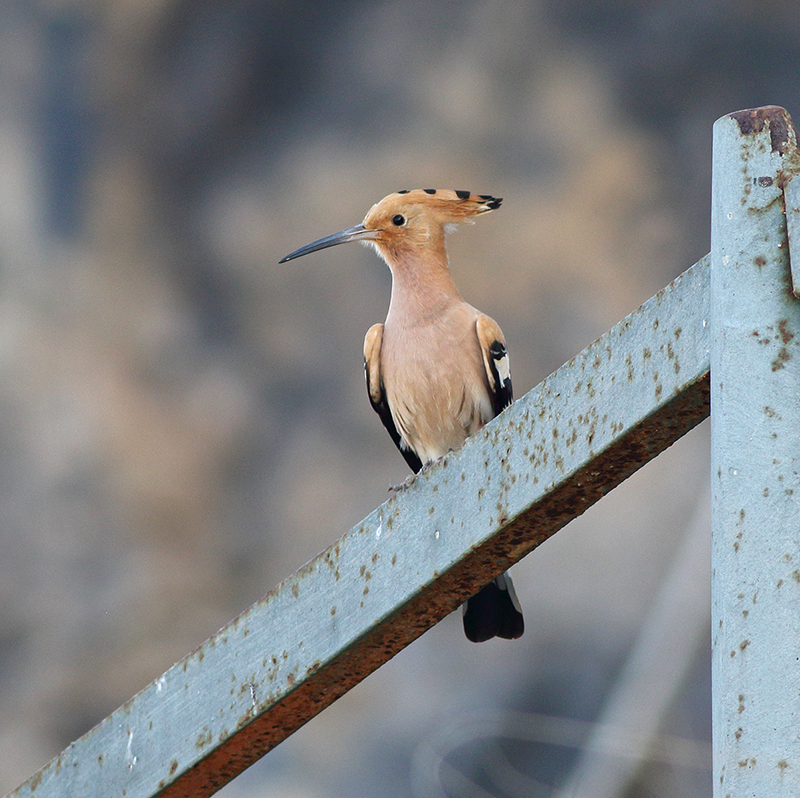
Immediately on parking up in the Hotel Cansani car park (beside the golf club) we heard then saw hoopoes (~ 6) plus several calling chiffs. As we wandered down towards the sea we came to the rear end of the stables where some of the hoopoes were feeding in amongst the discarded horse bedding. Unfortunately this was about 20 feet above our heads but I managed a few shots even if the setting was not what would have been desired.


Also at the stables was a kestrel and another raptor that I think was a barbary falcon but indecision as to whether to look at it or get a photograph as it went past meant I succeeded in neither. We also found another (very distant) gt grey shrike and had distant views of a spectacled warbler - the only one I actually saw.

The next day was our trip up to Teide. The route up via Vilaflor takes you past the Las Lajas picnic site where we stopped for an hour or so. On arrival I could hear a few  birds but most of them seemed to melt away before we saw them. Scanning the picnic tables showed no birds at all though a woodpecker drumming down the hill gave us something to search out and our first photo opportunity.
On returning to the main site we were watching a few canaries high up in the tree when I spotted a blue chaffinch at the base of it feeding on a large log. It seems the ranges have set up a small feeding area (a small offering of seed) and a drinking pool.
We moved closer then sat around and waited.


As we waited for the blue chaffinch in came half a dozen canaries, Canary Island blue tit (an African Blue tit) and the local variety of great spotted woodpecker.


All in all an excellent hour or so.

After that we went up to Teide (3500m) where I felt a little faint due to the altitude but whilst sitting around waiting for the others to finish their exploring I spotted a small bird flitting around. All sorts of thoughts went through my head because the temperature up there was -2C - snow bunting? snow finch? alpine accentor ? Needless to say I had to go and look. I found the bird and without doubt it was a Berthelot's pipit. I was both amazed and disappointed.

We came back down the mountain via the TF 38 which eventually takes you past Chio but on the way down you go past the Merendo de Chio picnic site. Here we saw more blue chaffinch (~5) but these were chasing each other around and we also found a number of Berthelot's pipits rummaging around under the tables plus a very cooperative one out in the open.


So I'd seen Berthelot's pipit at sea level (25C) at 1800m (~7-10C) and at 3500m (-2C) quite a remarkable range for a pipit.

The next morning I was up a little late so popped along to Fraile (a site mentioned in Wanstead Birder's report). All the normal stuff - chiffs, pipits, kestrel but I was determined to get some improved images of shrikes. Eventually I got close to one. In fact I was less than 10 yards from it in the end.


Being very bright you had to be on the sunny side of it so all the shots are head on.I never managed a decent side shot.

Yellow legged gulls were seen distantly every day but the only place I got near one was at Los Abrigos - a small harbour with a number of pleasant cafes so you can have a beer or ice cream in the afternoon sun whilst waiting for one to come and pose.


Our final outing was to Amarilla golf again but we spent most of the time just behind the beach where a pool has been formed. Here we saw grey wagtail, common sandpipier, redshank and a black necked grebe. Eventually the grebe came very close but what with the light and the fact that it was behaving like a phalarope whilst feeding on the surface insects photography was a little taxing. Still take enough and some will come out ok.


After the grebe we went back up to the stables to try for the hoopoe again but there was only one around and it stayed distant but another shrike posed for the camera.


From Amarilla Golf we took the back road to Las Chafiras where a small resevoir was home to around a dozen little egrets and 4 spoonbills.


Our final stroll along the prom on the last afternoon rewarded us with lots of chiffs, a kestrel and a pair of sanderling roosting on the rocks less than 10 yards from where everyone was walking past. Needless to say no one else even noticed them.


So what about Tenerife itself. Without doubt it is an amazing island offering desert on the coast and sub zero conditions an hours drive away. The scenery (away from the urban sprawl) is spectacular with extinct volcanoes (large and small) everywhere and the lava fields around Teide look like a different planet.
The birdwatching itself was quite strange in that the bird density, even of the frequently seen birds, was quite low so required a bit of searching but having found them proved reasonably easy to get decent images of.
If you go and stayed at Palm Mar or Golf del Sur you could get away with not having a car Berthelot's Pipit and Great grey Shrike are but a short walk away but I would recommend hiring one if you want to go further afield. We used CICARs and would recommend them - the price quoted (includes insurance) is what you pay and the pick up and drop off could not be easier.