Monday, 30 May 2011

Antigua - Day 10

Saturday 21st Last day.
I went out to out to Devil’s Point again today (no choice really as the car was gone). As I passed the beach/beach pool I flushed a great blue heron (I assume it was the same one I’d seen earlier in the week). The buff-breasted sandpiper was still on the point with the semi-p’s but without the car I couldn’t get near enough for any pictures.
The wind was a little stronger this morning so I’d hoped the sea watching would be a little more productive.
Sooty terns went past continually (64) as did roseates (15) and a couple of least terns. I managed a couple of shots of the roseate and although they won’t grace the walls of a gallery they show enough to confirm the id.
Roseate Tern

2 American oyster catchers dropped in on the other side of the bay and wandered round on the limestone pavement for ~ 30 minutes but we too distant to photograph.
One reason for continuing to grace Devil’s bridge was due to my hope of seeing a tropic bird so anything white was scrutinised with great interest. Hopes were raised then quickly dashed as a sea-going cattle egret flew past and landed on the point!
Cattle Egret

Throughout the sea watch I had been looking north because the wind was from the south east and everything was flying into it and towards me.  However from somewhere behind my right shoulder, hence flying downwind, something white flashed past, started heading into the bay changed its mind, turned back into the wind then shot past out to see never to be seen again. The whole thing had only taken a few seconds but I had seen a red-billed tropic bird and managed some crappy pictures. I just wish I had seen it coming.
Red-billed Tropic Bird

That signalled the end of my sea watch and I went off for breakfast.
We weren’t flying out till 4 in the afternoon so the rest of the morning was spent on the beach where I amused myself photographing fishing pelicans.

Brown Pelicans

They often synchronise their fishing efforts with their synchronised diving being as good as any seen in the Olympic Diving pool. They were also continually pestered by laughing gulls trying to nick a fish or two.
Pelican with Laughing Gull

Conclusion:
We chose Antigua primarily because it was where we honeymooned 25 years ago but as a destination to combine a beach holiday with some birding for a novice to the West Indies it really delivered.
In total I notched up 60 species 48 of which were life ticks and from a photography front I couldn’t have asked for more.
From my reading of other reports on birding in Antigua it would seem that a lot of the migrants species had already moved on with waders and ducks being very thin on the ground - though having said that I still managed to see 8 species of wader.  Being on the east of the island may have been a bit of a disadvantage (the major wetlands being on the west) however the hotel beach and it’s tidal pool, the mangroves and mud at Parham and sea watching at Devils Bridge were not mentioned in the other reports I had seen and provided a lot of the more interesting birds. The other real (and pleasant) shock was the heronry in St John’s –  just follow the ditch running down Tanner street!
All in all a great 10 days.

Sunday, 29 May 2011

Antigua Days 8 and 9

Thursday 19th
Had a look at Fitches creek this morning which was supposed to be a mangrove swamp however the water levels were high and lapping at the banks so I gave up and returned to Parham where mud was still on offer. During the drive I did however find 2 American kestrels on the wires.
American Kestrels

 On the mud there was a juvenile little blue heron, snowy egret, great egret, black necked stilt, semi-palmated sandpiper, Wilson’s plover and a clapper rail.
Little Blue Heron (juv)

Later that day 8 semi-palmated plovers turned up on the beach pool.
Day 9
Friday 20th
Back to the normal routine of Devil’s bridge before breakfast – this was fast becoming my “patch”and by now I was into counting things. The sea watch was pretty ordinary with only sooty tern (38), roseate terns(7),least tern (1) and 7 white terns (though in all probability roseates). I packed up after an hour but as I was leaving I noticed something different in amongst the semi-palmated plover (still 5) – a buff breasted sandpiper.
Buff-breasted Sandpiper

It seems this is a pretty rare bird for Antigua and one I was not expecting to see as judged by the reports I’d seen:
I then drove out to check out Potworks Dan. Whilst I had drawn a blank where with ducks a kingfisher (belted) I hadn’t completely given up hope. Well my hope was unfounded and it was the normal egrets and herons (snowy, great and green) and pied grebes (all distant). However on the photographic front it was a good day. On the way to Potworks Dam there are a few road-side ponds, the largest being only 15 yards across and today they produced photo-opportunity for white-faced pintail, little blue heron and greater yellowlegs. With the yellowlegs I was actually photographing one when a second dropped in even closer!
Little Blue Heron

Greater Yellowlegs

The was returned today so the rest of the day was spent on the beach where 3 royal and 1 roseate tern was seen as were 7 pelicans who spent the day in the bay.

Saturday, 28 May 2011

Antigua Days 6 & 7

Tuesday 17th

Only had a pre-breakfast session today. I went to Parham again and I saw (but failed to photograph) a reasonably close great blue heron and I found a juvenile little blue heron close to the road. Also at Parham I saw several black necked stilt, 2 Wilson’s plovers and a lesser yellow legs. I managed to get some pictures of the latter but I got a lot better ones later in the week.
We spent the afternoon on the beach so I checked out the beach pool and found the spotted sandpiper showing very well:
Spotted Sandpiper

Wednesday 18th.
Went to Devil’s Bridge before breakfast and saw 28 sooty terns (started counting properly!) managing some decent images, 2 roseate terns and 1 least tern plus the resident semi-palmated plovers.
Sooty Tern

On the drive back to the hotel an Antillean crested hummingbird sat a posed for the camera – the crest showing different colours depending on how the light catches  it. These were seen at regular intervals during the holiday  though they were hardly what I would call common.
Antillean Crested Hummingbird

Back in the hotel grounds a black whiskered vireo likewise posed well.
Black-whiskered Vireo

We did go out to Wallings reservoir hoping for quail doves and thrashers but saw nothing of note. This was undoubtedly the biggest let down of all the places we visited (bird-wise) though whether this was down to the me, the time of the day (late morning) or whether the place had deteriorated I have no idea.
After we visited Jolly Beach/Jolly Harbour (because we stayed there 25 years ago). The ponds around Jolly beach contained very little though at Darkwood a juvenile yellow crowned night heron was seen.
Juvenile Yellow-crowned Night Heron
 Jolly beach itself was a disappointment but we had a nice lunch at Jolly Harbour and a green-thoated carib posed nicely for the camera. 
Green-throated Carib

Thursday, 26 May 2011

Antigua - Day 5

Monday  16th
Morning started at Devil’s point but it was much the same as before though this time I did actually do some counts - 4 brown boobies, 42 Sooty terns, ~12 “white” terns, 8 least terns and 6 Roseate terns.
After breakfast it was back to St Johns with the shops being open. For Angie the highlight was the shops but for me it was the herons in the ditch. This is the ditch:
Tanner Street Ditch

It was actually an open drain from a pond at the top of the hill with water coming in at various points (including from a car wash). The pictures shows the ditch from the bottom and widest point. It then flowed into the harbour though some rocks and vegetation.(There is actually a snowy egret in the picture but it's too small to see clearly)
And here are some of the herons:
Green Heron

Tricoloured Heron

After St Johns we went back to McKinnons Ponds. We saw all the common stuff (Sandwich terns, least terns, pelicans, frigate birds, white faced pintail) another willet, some black necked stilts (I think I have forgotten to mentin them before but we saw them on just about every wetland we visited), and a distant little blue heron but wader numbers were down from our first visit.
Black-necked Stilt

Willet

Least Tern

Frigate Bird

Antigua - Day 4

Sunday 15th
It was overcast and trying to rain first thing drove off  and promptly managed to get lost. I suppose the time finding my way wasn’t completed wasted as I found a pond holding a juvenile pied billed grebe. I parked up and waited for a parent to appear but gave up after 10 minutes.
Juvenile Pied-billed Grebe

After I had regained my bearings I found a broard-winged hawk sitting on the wires opposite the Sir Viv Richards Stadium then continued on to the mangrove swamp near Parham. What a brilliant decision it was.

Broad-winged Hawk


As I pulled up I spotted a whimbrel but it disappeared behind the mangrove trees so no picture. However as I sat there I heard a loud kek-kek-kek-kek call. After a few minutes searching I found a rail up in a small mangrove tree preening. A few shots later and a quick look at the book confirmed it was a clapper rail. The reports I’d seen on Antigua had suggested they were present in this area but no one had seen on. Well there were 2 there, the one in the tree and another more distant one. It soon came out of the tree and departed.
Clapper Rail

No sooner had the rail disappeared when a mangrove cuckoo flew into the bush just in front of me then into the bush alongside me – less than 10 yrds away. I never managed a clear view of the bird but despite the light rain I did get some reasonable head shots.
Mangrove Cuckoo

I moved on a little way and parked up again and spotted a duck flying orange looking duck flying towards me – a fulvous whistling duck. It went over the car and landed on the landward  side of the road but walked off into the wet scrub before I could get a shot.
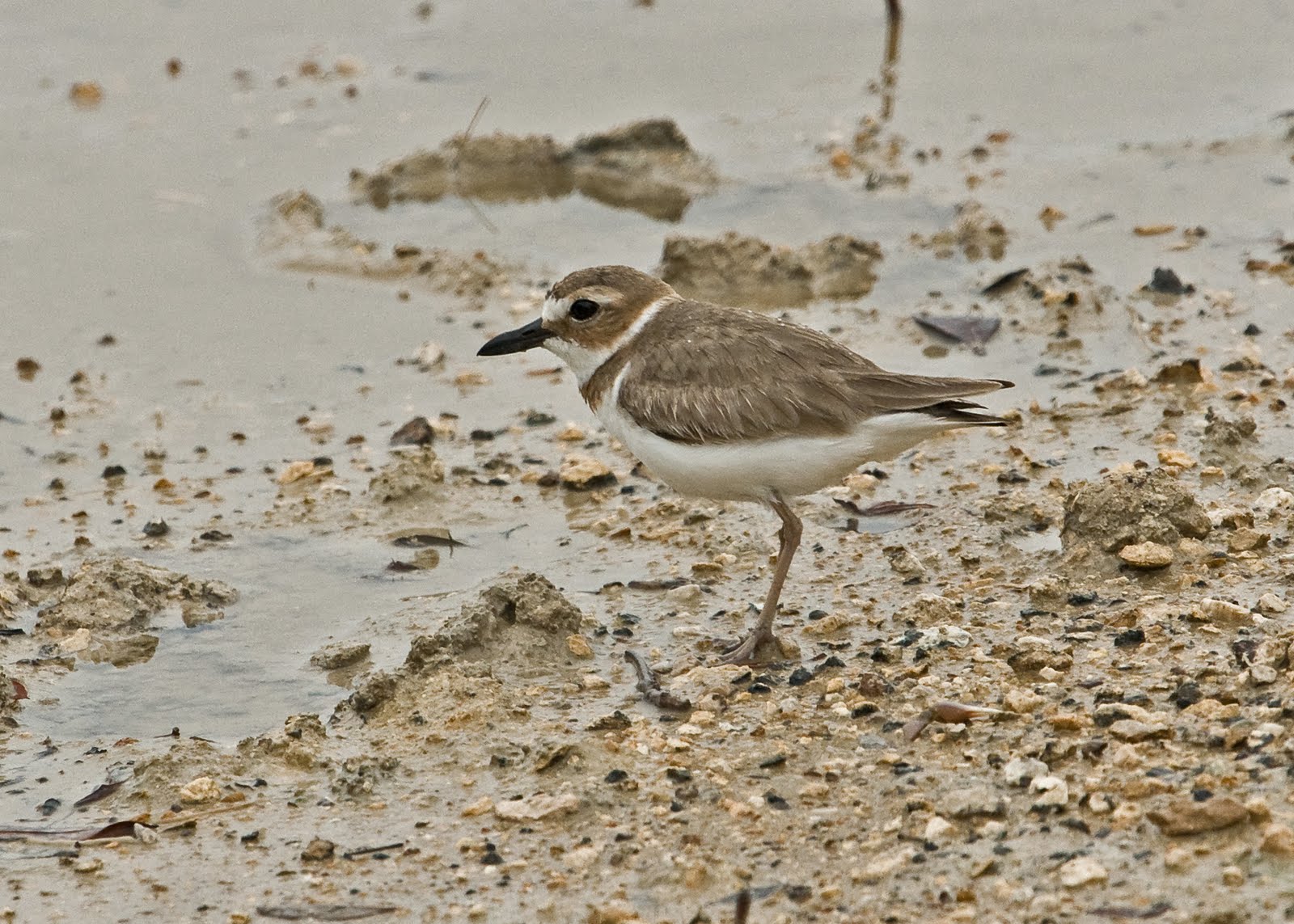
Another move and I found 3 Wilson’s plovers and managed some pictures then it was back to the hotel for some breakfast.
Wilson's Plover

Later that morning Angie and I drove over to St John’s, the capital. Angie was hoping for a bit of retail therapy but the shops were all shut (it was Sunday) but we did see 3 Caribbean  martins over the harbour and a heronry on the harbour shorefront containing snowy egret and green and tricoloured heron, with the herons coming to feed in a small ditch by the car park. No pictures but I would have the camera with me when we came back the next day.

Wednesday, 25 May 2011

Antigua Day 3

Saturday 14th

Saturday morning I covered the same ground as on Friday and got off to an excellent start as I finally managed to see a black whiskered vireo in the hotel grounds. I think these are reasonably common but proved difficult to see; in fact I only ever saw them early morning though I did (once I’d worked out the call) hear them at other times of the day.
Black-whiskered Vireo

I then went out on Devils Bridge again. The 5 semi-palmated plovers were still there but as soon as I reached the sea watch position 2 brown boobies drifted past. A mad scramble to get the camera out resulted in a few record shots.
Brown Boobies

As with the previous day there was a steady stream of sooty terms going past plus Sandwich and least terms and more of the “white” terns (now thought to be roseates).
On the way back the pool had the green heron and the spotted sandpiper but nothing new.
At 10.00 I picked up the hire car (a 4WD) and Angie and I went for a drive around. On the way to Potworks Dam we had white winged pigeon on the outskirts of the nearest town to the hotel  (a town called Willikies )  and at the Potworks dam we had pied grebes, snowy and great egret and a distant tricoloured heron. Whilst parked up I saw a bird fly into a tree and on getting closer saw it was a broad winged hawk:
Broad-winged Hawk

We continued our drive and close to the Sir Viv Richards stadium there were a flock of cattle egret with the road-side goats and I managed some great close-ups.
Cattle Egret

We then visited the mangrove swamp which can be viewed from the Parham Harbour to St Johns road. Here we saw more semi-palmated plovers and ~6 small dark legged waders which I’m pretty sure were semi-palmated sandpipers.
In the afternoon we drove out to Devils Bridge (Angie had not been out there) with Angie stopping the car every time we saw a yellow warbler – the results were spectacular:
Yellow Warbler

These were actually pretty common throughout the island. They could even be seen in the hotel grounds but only in the wilder areas especially areas adjacent to the scrubby areas outside the fence line. I could never get close to these on foot but they seemed to ignore the car completely.
On the point itself it was very much the same as the morning session though there was a small sandpiper present that was probably a semi-palmated but could have been a western sandpiper. These are pretty similar and the pictures I managed were not good enough to tell the difference.

Tuesday, 24 May 2011

Antigua Day 2 - Hotel and local area

Friday 13th
The day started much the same as the first day with me visiting the beach but only the spotted sandpiper was in residence. However a fortuitous glance at the sky revealed a distant osprey carrying a fish.  A little later there were 2 cruising around but they never came close enough for a decent picture.
Osprey (with fish|)

Since nothing was going on on the beach I walked out to Devils Bridge – a promontory that juts out into the sea and provides one of the most westerly parts of the island and only ~ 1/2 mile walk from the hotel. The scrub I passed on the way held all the common stuff but as I reached the grass covered end of the peninsular I found 5 semi-palmated plovers. These seemed to be resident as I saw them every day I visited this site.
View of Devils Bridge from our room

Semi-palmated Plover on Devils Bridge
I took up station at the very end for a bit of sea watching and within a few minutes sooty terns were passing – they were too distant to get anything other than record shots that confirmed the id. Also going past were some “white” terns that at the time I couldn’t id but now think are roseate terns. A few least terns also went past.
Sooty Tern and (assumed) Roseate Tern

After an hour or so I returned to the beach pool and found the green heron had returned and a superb yellow crowned night heron had turned up. This wandered around in broad daylight for ~ 30 minutes giving brilliant views.
Yellow Crowned Night Heron

To top it all one of the royal terns started fishing in the bay.
Royal Tern

 After that it was back to the room and off to breakfast.
The rest of the day was spent cooking in the sun and drinking ............