Wednesday, 25 July 2012

Backsand 23/24th July.

The last 2 days have followed the same routine – a tour of the local SBBO recording area then down to Backsand for the high tide (15.40 on the 24th).
The tours of the SBBO area produced little of interest other than 3 brown hawkers (23rd) and 23 dunlin on the beach (again 23rd).
Brown hawker

Dunlin

The gull in the background was a pain in the proverial. The dunlin were making there way fown the beach towards me but everytime a dunlion found a worm he tried to take it. In the end they gave up and flew off.
On both days Backsand held a few ducks – a family of mallards and of tufties, plus 2 little grebes, 40-odd grey lags plus common and green sand pipers and greenshanks.
Green sandpiper cooling off

Common sand plus small worm

Little grebe

On both days the pattern was the same – a few green and common sands present when I arrived an hour before high tide with the numbers growing as high tide approached – final numbers being common sandpiper 6 and 5; green sandpiper 8 and 10 and greenshank 11 and 9.
On the 23rd both green and common sand spent a lot of time in front of the hide but on the 24th they kept their distance and only the occasional common sand came across the front.
On both days the common sands were very mobile calling and displaying to each other:

Common sandpiper displaying

This increased shyness  may have been due to ringing activity as the ringers had an overnight session at there on Monday night. Interestingly one of the birds they caught was ringed at Backsand last year showing that some at least frequent the same haunts.
Today a little ringed plover turned up but it was also shy not coming close enough for a decent picture.
Little ringed plover
On both days the greenshanks were a huge disappointment in that they slept the whole time – not one went looking for food and redshanks were completely absent.
Water levels are very low (excessive pumping) and there’s a real chance it could be virtually dry if we have a prolonged hot period..............I hate to say it but it could do with a few inches of rain!

Wednesday, 18 July 2012

Scratching around for something to photograph

A wander round Sandwich this morning was not very rewarding though whilst we were at Restharrow Scrape a wood sandpiper flew in;  the only other bird of note was a common sandpiper and that was miles away.
Wood Sandpiper
On the way home I spotted a hobby on the fence line near Dickson’s corner. I stopped the car and managed a couple of shots before the bird flew off and that was the last I saw of it.
Hobby
It was too early to go home so I went to the old rifle range at Kingsdown.
I immediately found the hoped for kestrel, a juvenile, but it stayed high on the cliffs and kept moving along the cliff face as I approached so no pictures. At the southern end of the range I found a couple of rock pipits carrying food. I didn’t stay long as they seemed to be a little disgruntled at me being there.
Rock pipit
There were a few house martins hawking the cliffs and I found 2 (possible 3) nests with young – nice to see but only a fraction of the number nesting there only a couple of years ago. Whilst watching what they were doing I noticed 2 were visiting a puddle collecting mud so I sat close, partly hidden by one of the numerous signs and waited.
House Martin
Many years ago I was watching “Out of Town” with Jack Hardgreaves (shows my age I know) when he was discussing whether house martins collected the mud in their mouth or on the top of their beak. I wouldn’t swear to it but my recollection is that he thought they carried the mud on the top of their beaks was but my photographs show they clearly collect it in their mouths!!

Mud collectiing

I’d only been there 10-15 minutes when it started to spit with rain so I packed up and went home to watch le Tour – great stuff.

Wednesday, 11 July 2012

Scrape update


Restharrow scrape has enjoyed a few waders over the last week or so in the form of common, green and wood sandpiper and a little ringed plover. Today only the LRP and the green sand was present (whilst I was there) but they did come onto the islands near the hide so allowed a few record shots to be obtained.
Green sandpiper
Little ringed plover
The little grebes on the scrape are taking food to the nest (mainly leaches as far as I can see) though one chick has been seen. Other than that it’s only common stuff including a flock of ~30 grey lag.
The ringers have been pumping Backsand for several days now and at last some mud has appeared (though with the weather forecast it could well disappear again!). I went down there yesterday from 11.00 till 1.00 (all wrong for the tides) because a spoonbill had been seen by the ringers when they went to check the pump early morning. They had also seen a few greenshank and green sandpipers. Needless to say that when I got there there was no sign of the spoonbill and the only waders present were 3 oyster catchers – 2 adults and a near fully grown juvenile.
There is a little grebe down there but I have no idea whether it/they have a nest/young.
There were 3 little egrets in residence so I spent the morning trying to photograph them. One in particular spent most of its time in front of the hide but the light was poor with numerous showers so despite getting into some very interesting poses the images quality suffered markedly (especially with noise).


Little egret
The dragonfly pool has now been dug and the excavated sand/soil graded into a shallow bank. Now we have to wait for it to fill and the insects to move in.

Thursday, 5 July 2012

Restaharrow and Backsand update (4th July)

With the forecast looking good I decided to check out Restharrow and Backsand Scrapes.
I wasn’t going to do Backsand but since the water levels on Restharrow had dropped significantly over the last week or so it seemed worthwhile.
Restharrow was disappointing. A common sandpiper had been seen earlier in the week and a green sandpiper earlier this morning but all that was there when I was there was a lone redshank and that was miles away. Other than that it was as it has been for the last month, little grebe, coots, lapwings, oycs and a few tatty looking mallards and gulls. The only bit of interest were the house matins (and a lone swallow) which were collecting mud from the island in front of the hide. I took a few images to adorn this posting and the martins decided that was a cue to fight (or they could have been attempting to  mate) whatever it was it looked pretty violent.

House Martins
As I entered the Estate I noticed excavation going on in the adjacent field. The Obs have signed a lease for some more land – the field adjacent to Restharrow scrape - and have planning permission to dig another pool. This pool is being set out specifically for dragon flies though I suspect ducks and little grebes may find it attractive. What was amusing this morning was the antics of the cows – they had climbed into the embryonic pool and the digger man was trying to encourage them to leave.
Inspectors of Holes
Sorry about the picture but I only had the 400mm lens.
Newdowns to Backsand was very quiet, just a few chaffinch, house martins, reed warblers, whitethroats and a lone Cetti’s called from the rear bank of the reservoir bund. My last few walks down to Backsand have been enlivened by hares (5 on the last visit) and grey partridge but not today – I saw none.
Backsand was a big disappointment. After seeing the water levels at Restharrow I was expecting to see some mud banks but the water is still too deep so the only mud is around the main islands. On the duck front  there were 15 tufties (all adults going into eclipse) and a couple of dozen mallard (plus 3 juvs). There were 2 little egrets on the river and another 3 on the scrape but 2 of those soon flew off,
The field either side of the track leading to Backsand have wheat in them this year and it is covered with small snails (~ ½ inch across). I have no idea what species they are but they must be doing quite a bit of damage.

So anyone thinking of going down Backsand should wait a few more days in the hope it dies out some more though it rained quite a bit in Kingsdown last night; pumping the water out may be the only answer after the wettest drought in living memory..

Friday, 29 June 2012

Scotland - Osprey and Black Guillemots

The last few days I have been on a tour of the northern most regions of the Greater Kent recording area – popularly known to others as Scotland.
On Thursday, possibly one of the wettest days in living memory, we drove from Kingsdown to Perth (Scotland) and it rained big time the whole of the way. Things couldn’t have started much worse with it taking nearly 3 hours to reach the M1 despite us leaving the centre of the universe at 5.15; the traffic improved after that even if the weather didn’t.
Nominally we were going to Scotland to see a great nephew but in reality it was to give me a chance for some birding in the north – weather permitting.
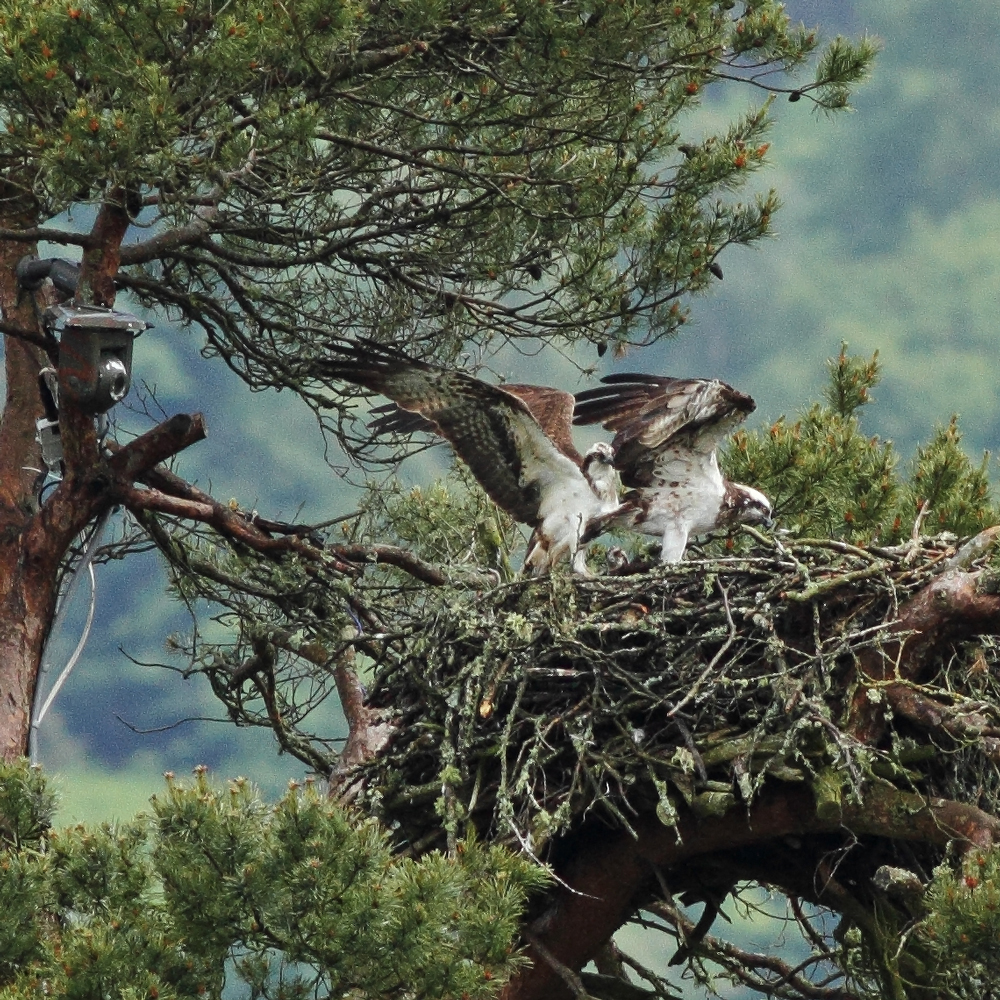
On the Friday Angie spent the day with the little fellow but I spent the day at the Loch of Lowes watching the ospreys. Ospreys have nested at the Loch for years and they can be watched on line. From the hides they are ~300 yards away; close enough for great views but a long way away for a 400mm lens and the weather was not great – overcast all of the time and raining most of it. Still, I saw the two resident birds and 2 more flew past to boot. I asked one of the wardens just how many ospreys were in the area and was told there were 55 breeding pairs in Perthshire plus a number of non breeders. I had no idea there were so many up there. It makes my sighting of 4 pretty average.
Ospreys plus web cam to the left

Whilst the bird are always in sight they approach and depart from the far side of the nest so they never actually came closer than the nest itself.  Also they don’t often fish on the Loch of Lowes itself preferring to go along the valley to the neighbouring lochs. One of these (Butterstone) is a trout fishery and you can (if your luck is in) watch the ospreys fish there whilst have morning coffee or afternoon tea from the cafe at the fishery. I had a coffee there and 2 ospreys turned up but they circled high up for a few minutes before drifting off west without actually fishing.
Osprey from Butterstone
On the Saturday I spent the early hours of the morning on the coast just west of Dundee (the easiest place to get to sea/beach) where I found several flocks of eider (the males coming into eclipse) with each flock having a few red breasted merganser with them. Also along the beach I found curlew, oyster catcher and a lone bar-tailed godwit – nothing exciting but nice to see.
Bar-tailed godwit

Eider and RB mergansers
Around lunchtime we departed for Oban. I would have liked to spend a few days at Oban trying to see the eagles but time didn’t allow and my hope was to see black guillemot (a life tick) which live in the harbour. The journey from Perth to Oban took 3 hours and it rained most of the way. Luckily soon after we arrived it cleared up and whilst not sunny it was dry so at around 4 pm Angie and I walked down the harbour. We checked around the pier and found nothing of note – just a few herring and common gulls. I think the guillemots lived here once but there is a lot of touristy activity on the pier now (including 2 large restaurants) so they may have been scared away. As we stared to walk north along the prom (Corran Esplanade) we found a  confiding rock pipit and 2 hooded crows pecking at what I thing was a dead juvenile jackdaw.
Hooded crow
I had been on the lookout for hoodies throughout the drive from Perth but saw none so this was a real bonus. The hoodies took no notice of people (including me) walking along the esplanade but as soon as I stopped to try and photograph them they were off. Fortunately the lure of the jackdaw was too great an opportunity and they soon returned and I got a few shots.
In normal times I would have spent more time with them but we still hadn’t seen a black guillemot so we moved on. Half way along the esplanade I spotted some movement way out to sea – my first black guillemot - then Angie spotted a head poking out of the sea wall a hundred yards or so away. The guillemots nest/roost in the storm drains and lot of shots are on the internet showing them looking out but it was great to see it.
Black guillemot from a storm drain

The next hour or so was spent watching a lone pair of black guillemots. Their time was spent in the drain, flying in a circle out to sea and back and resting on a small jetty covered with sea weed. They did allow me to get pretty close when they were on the jetty but they didn’t land on the prom itself – something they are reported to do. Eventually we spotted another pair way out to sea. 

Black guillemot

After dinner (~9.30pm) we walked along the prom again but there was still only the two present..
The next morning was dry but overcast and I got to the prom at 5.30. Still no guillemots around the pier but along the prom up towards the cathedral I could see several sitting on the top of the sea wall/prom and hurried off for a closer look. I needn’t have bothered hurrying because they were there all morning.
I quickly marched up, ignoring the hooded crows, and started the taking pictures of the birds sitting on the prom (despite the light being rubbish).
As I hung around the guillemot numbers increased to 26 and the views were outstanding - at times they were too close to photograph – whilst standing above one of the storm drains they would fly straight at me into the hole or land 4 or 5 feet away from I was standing then even walked towards me. The experience was similar to the puffins at Skomer and like Skomer I took hundreds of pictures of them - on the prom, on the weedy jetty and on the water.


As the tide was in there was 2 or 3 feet of crystal clear water beside the sea wall so you could watch them flying underwater as they fished. The light slowly improved a little and some very pleasing shots were obtained but it was not good enough for BIF. Around 8.30 I returned to the B&B for breakfast and we packed up to leave. Just as we were getting into the car the sun came out so we had to delay our journey south whilst I took some more pictures. I concentrated on BIF shots but despite the light being better I still struggled – dark birds, loads of glare from the water and them flying at 200 mph – it was very like trying to get shots of puffins in flight.

I’m not sure where they were in their breeding cycle because some seemed to be courting and there was no evidence they were bring fish to the nest. There was also the occasional fight which was somewhat more dramatic than coots because the fight took place on the water, under water and in the air:


Scrapping black guillemots
After a while the sun disappeared and It was off the Ambleside (Lake District) for 3 days where we had a great time walking, sight-seeing and eating but the birding was poor. I only birded pre-breakfast and the first morning I went looking for dippers. I tried several different streams in the area but no luck. It proved very difficult to follow a stream for any distance because they either disappeared into deep gorges with no stream-side paths or off into private gardens/land. Also the streams were also more like raging torrents after all the rain the NW had suffered.
The second morning I drove up into the hills (Kirkstone Pass on the A592) to try my luck with some upland species. The drive up provided mippit, pied wag and skylark then I parked at what I think was Broad Stone (just a car park and a pub) and walked up the very steep track towards the rocky outcrops. On the way up I could hear a golden plover calling but I couldn’t find it though whilst searching I did find 2 male wheatears  and I heard a ring ouzel call once but that was it really.
The lakes themselves were pretty devoid of bird life. The only wildfowl we saw were species who liked being fed bread – mallard, mute swan, plus greylag and Canada geese; we didn’t see any other duck species.  Before we went I searched the internet for birding reports from the Lake District and found very little and what I did find was about the coastal reserves. There was nothing about the lakes and hills...........I think I found out why!.
More pictures of the guillemots will appear on my Flickr site for anyone interested

Thursday, 14 June 2012

A Tour of the Recording Area

Sorry about the lack of activity over the last couple of weeks but the reality has been that I’ve had nothing much to report – in part due to the weather and in part due to the dearth of birds in East Kent.
After a few days stuck inside due to the weather today (Wednesday 14th) promised sun so I decided to go for the big one – a walk from Newdowns Farm to Backsand , then along the river bank to the point and back to the car along the beach and across Princes.
The day started well with a grey partridge feeding close to the Ancient Highway as I drove to Newdowns. 
Greyt Partridge
The walk from the poly tunnels to Backsand revealed the normal summer residents – sedge and reed warblers, a few whitethroat, a lone blackcap, and a few skylark and mippit but it was good for hares – there were 3 in the first field (alongside Newdowns reservoir) and another 3 in the last field before you turn back on yourself to get to Backsand itself. In the same field was a red legged partridge.
The water levels on the scrape are very high after the rain so there were no waders at all, just a few ducks – mallard (25) and tufties (9) mainly plus a couple of grey lags and shellduck and a little egret. If the weather carries on as it has (ie raining) then Backsand may have to be pumped out for the wader migration. On the warbler front I only had singles of sedge, reed and Cetti’s warbler and a lone whitethroat
After Backsand I went up on the river bank and walked to the point. The bank-side scrub held a good head of whitethroat (16 singing males) and lesser whitethroats (6 singers) but the numbers of other warblers were very low. I did try several times to photograph a lesser but they would have none of it. A juvenile whitethroat was much more obliging:
Whitethroat
On the salt marsh I had a couple of little egrets and a grey heron but no waders other than 6 curlew and a few oyster catchers. Up near the point  38 seals were sun bathing.
On the Shellness Nature Reserve (or 100 acre field if you prefer) there was very little other than skylarks, linnets and mippits (8 to 10 of each). The highlight was a pair of stonechats and I found a lone corn bunting. The beachside sea buckthorn produced even less – it was more or less lifeless.
Throughout the walk the shortage of  reed bunting was really apparent – I only noted 8 for the whole walk and I didn’t see a single raptor. Orchid numbers were very good though (Marsh orchids on the 100 acre field and pyramidal on the beach track) with most now coming into flower.
After a coffee in the Obs I stopped off at Dickson’s corner because a hobby was in residence. It was joined by a second for a short period but the second bird didn’t linger. I did on several occasions manage to get pretty close to the bird perched on a fence post but always when I was shooting more or less into the sun.
Hobby on a stick
I was making my way back to the car and standing on the road when the bird flew along the track and landed on a post quite close by but low(ish)shutter speed/poor panning technique ensured the pictures were not very sharp. Still it was a nice way to end the session.


Hobby landing


Monday, 4 June 2012

Small stuff in Mid Wales

This last posting on our trip to Mid Wales will concentrate on small birds - redstarts, flycatchers and finches.
After breakfast each morning we went to Gilfach and I spent 2 sessions there with the pied flys and redstart, my principle aim being to get a decent redstart picture.
On Monday we eventually managed to leave the hotel at about 9.00 the delay being because Steve was trying to stop his camera sling from squeaking! We did see the garden redstart and spot fly whilst we waited but they were very shy. It was the only spot fly I managed to see during our visit.
Spot flycatcher in hotel garden
Once at Gilfach we stopped at the Otter hide and asked the only guy there how things were. Very quiet he suggested, with the birds keeping high in the canopy or in the nest boxes - 2 were occupied by pied flycatchers within 10 yards of the hide. Well, we put out some meal worms (as he claimed to have done) and within a minute or two we had pied fly (male and female) and a pair of nuthatch feeding within 4 or 5 yards of where we were standing. We weren’t in the hide, we were outside and in full view of the birds! I don’t know whether the guy in the hide didn’t want us there or was blind but we got some cracking shots.
Male Pied Flycatcher

Female Pied Flycatcher

Nuthatch
The only downside was there was no sign of the dipper that nests beneath the adjacent bridge.
We then went up to the visitor centre. When we arrived there were 2 photographers already there, one with a blue hat (referred to in the dipper post as Pillock) who had a 500mm lens and was standing about 4 yards from the wall upon which the redstart lands and another guy. Pillock told us the redstart wouldn’t be put off by how close we were so we put out some meal worms. He then talked to his mate and anyone else within 20 yards at the top of his voice for the whole morning – normally about some football team or another or how he was a professional photographer working on a commission.  Amazingly the pied flys were not put off by his noise but the redstart was very cautious and wouldn’t come into feed.
Male Pied Fylcatcher
Also seen around the visitor centre was siskin and redpoll but they too were pretty skittish and didn’t linger long on the seed feeders by the wardens house and on one of the days we had a singing and displaying crossbill high above where the redstart was feeding.
We returned to Gilfach on Tuesday morning but this time went straight to the visitor centre. At the beginning we had the place to ourselves, we set up the cameras a little further away from the wall from the previous day, put out some meal worms and waited quietly. We soon had the male redstart feeding pretty freely, though it was never as confiding at the pied flys who would sit there for ages as we fired away with the cameras.

Male Redstart
As the morning progressed a few more photographers arrived (but thankfully not Pillock) and although the redstart continued to come to the wall I went down to the Otter hide hoping for the dipper. I saw it but that’s about all you could say.
Tuesday, after Gilfach we went to Nant yr Arian for the kites (see earlier posting) but the real highlight for me were the feeders. They were right by the visitor centre so you could watch siskin, chaffinch and green finch at close quarters whilst having a cuppa – my type of birding. Also in the adjacent woodland was a pair of bullfinch. These wouldn’t come to the feeders but they did feed on the ground below them and land in the bushes 30-40 yards away. Getting siskin shots on the feeders was trivial as there were normally 3 or more on the feeders at any one time but getting them on twigs, in the sun and un-obscured by twigs took a bit more effort...... but not a lot.
Juvenile siskin

Male siskin with eye infection

Male bullfinch

Our only disappointment with the feeders was the lack of redpolls; we didn’t see any in the reserve but we did see  redstart and pied fly on the path leeding to the kite feeding area.
So that’s about it for my Ashton Tours account. We had no rarities but then we didn't go there for that reason. We succeeded in photographing most of our target birds - red kite, buzzard, dipper, redstart and pied flycatcher but failed with  wood warbler though they were in the Elan valley.  We found one on the hill a couple of hundred yards from the hotel and there was a pair on the hillside near the dippers but the views were at best fleeting and always distant though in reality we didn;t put much effort in.