Thursday, 26 May 2011

Antigua - Day 4

Sunday 15th
It was overcast and trying to rain first thing drove off  and promptly managed to get lost. I suppose the time finding my way wasn’t completed wasted as I found a pond holding a juvenile pied billed grebe. I parked up and waited for a parent to appear but gave up after 10 minutes.
Juvenile Pied-billed Grebe

After I had regained my bearings I found a broard-winged hawk sitting on the wires opposite the Sir Viv Richards Stadium then continued on to the mangrove swamp near Parham. What a brilliant decision it was.

Broad-winged Hawk


As I pulled up I spotted a whimbrel but it disappeared behind the mangrove trees so no picture. However as I sat there I heard a loud kek-kek-kek-kek call. After a few minutes searching I found a rail up in a small mangrove tree preening. A few shots later and a quick look at the book confirmed it was a clapper rail. The reports I’d seen on Antigua had suggested they were present in this area but no one had seen on. Well there were 2 there, the one in the tree and another more distant one. It soon came out of the tree and departed.
Clapper Rail

No sooner had the rail disappeared when a mangrove cuckoo flew into the bush just in front of me then into the bush alongside me – less than 10 yrds away. I never managed a clear view of the bird but despite the light rain I did get some reasonable head shots.
Mangrove Cuckoo

I moved on a little way and parked up again and spotted a duck flying orange looking duck flying towards me – a fulvous whistling duck. It went over the car and landed on the landward  side of the road but walked off into the wet scrub before I could get a shot.
Another move and I found 3 Wilson’s plovers and managed some pictures then it was back to the hotel for some breakfast.
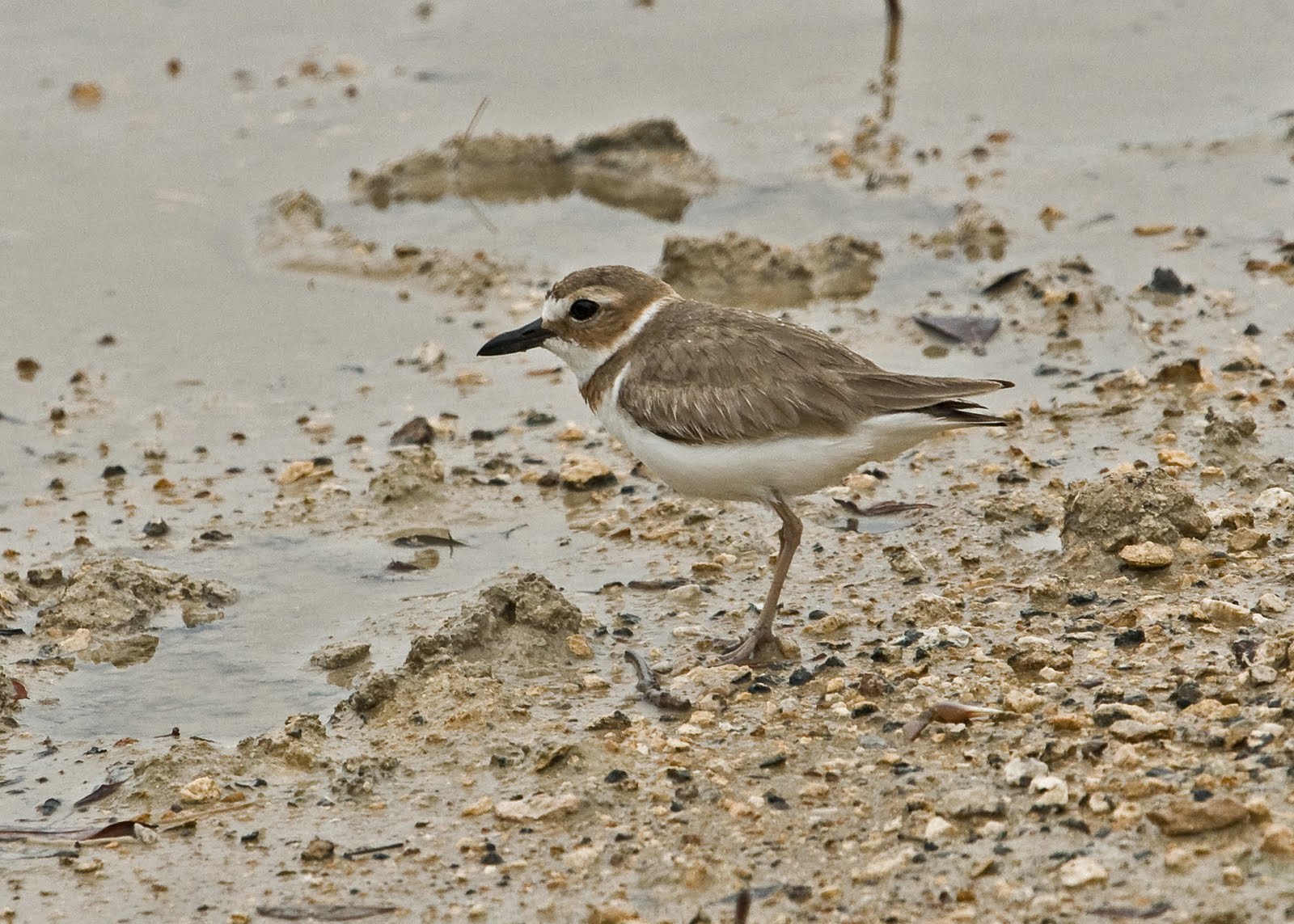
Wilson's Plover

Later that morning Angie and I drove over to St John’s, the capital. Angie was hoping for a bit of retail therapy but the shops were all shut (it was Sunday) but we did see 3 Caribbean  martins over the harbour and a heronry on the harbour shorefront containing snowy egret and green and tricoloured heron, with the herons coming to feed in a small ditch by the car park. No pictures but I would have the camera with me when we came back the next day.

Wednesday, 25 May 2011

Antigua Day 3

Saturday 14th

Saturday morning I covered the same ground as on Friday and got off to an excellent start as I finally managed to see a black whiskered vireo in the hotel grounds. I think these are reasonably common but proved difficult to see; in fact I only ever saw them early morning though I did (once I’d worked out the call) hear them at other times of the day.
Black-whiskered Vireo

I then went out on Devils Bridge again. The 5 semi-palmated plovers were still there but as soon as I reached the sea watch position 2 brown boobies drifted past. A mad scramble to get the camera out resulted in a few record shots.
Brown Boobies

As with the previous day there was a steady stream of sooty terms going past plus Sandwich and least terms and more of the “white” terns (now thought to be roseates).
On the way back the pool had the green heron and the spotted sandpiper but nothing new.
At 10.00 I picked up the hire car (a 4WD) and Angie and I went for a drive around. On the way to Potworks Dam we had white winged pigeon on the outskirts of the nearest town to the hotel  (a town called Willikies )  and at the Potworks dam we had pied grebes, snowy and great egret and a distant tricoloured heron. Whilst parked up I saw a bird fly into a tree and on getting closer saw it was a broad winged hawk:
Broad-winged Hawk

We continued our drive and close to the Sir Viv Richards stadium there were a flock of cattle egret with the road-side goats and I managed some great close-ups.
Cattle Egret

We then visited the mangrove swamp which can be viewed from the Parham Harbour to St Johns road. Here we saw more semi-palmated plovers and ~6 small dark legged waders which I’m pretty sure were semi-palmated sandpipers.
In the afternoon we drove out to Devils Bridge (Angie had not been out there) with Angie stopping the car every time we saw a yellow warbler – the results were spectacular:
Yellow Warbler

These were actually pretty common throughout the island. They could even be seen in the hotel grounds but only in the wilder areas especially areas adjacent to the scrubby areas outside the fence line. I could never get close to these on foot but they seemed to ignore the car completely.
On the point itself it was very much the same as the morning session though there was a small sandpiper present that was probably a semi-palmated but could have been a western sandpiper. These are pretty similar and the pictures I managed were not good enough to tell the difference.

Tuesday, 24 May 2011

Antigua Day 2 - Hotel and local area

Friday 13th
The day started much the same as the first day with me visiting the beach but only the spotted sandpiper was in residence. However a fortuitous glance at the sky revealed a distant osprey carrying a fish.  A little later there were 2 cruising around but they never came close enough for a decent picture.
Osprey (with fish|)

Since nothing was going on on the beach I walked out to Devils Bridge – a promontory that juts out into the sea and provides one of the most westerly parts of the island and only ~ 1/2 mile walk from the hotel. The scrub I passed on the way held all the common stuff but as I reached the grass covered end of the peninsular I found 5 semi-palmated plovers. These seemed to be resident as I saw them every day I visited this site.
View of Devils Bridge from our room

Semi-palmated Plover on Devils Bridge
I took up station at the very end for a bit of sea watching and within a few minutes sooty terns were passing – they were too distant to get anything other than record shots that confirmed the id. Also going past were some “white” terns that at the time I couldn’t id but now think are roseate terns. A few least terns also went past.
Sooty Tern and (assumed) Roseate Tern

After an hour or so I returned to the beach pool and found the green heron had returned and a superb yellow crowned night heron had turned up. This wandered around in broad daylight for ~ 30 minutes giving brilliant views.
Yellow Crowned Night Heron

To top it all one of the royal terns started fishing in the bay.
Royal Tern

 After that it was back to the room and off to breakfast.
The rest of the day was spent cooking in the sun and drinking ............

Monday, 23 May 2011

Antigua (cont)

Day 1 PM.
In the afternoon we had hired the services of Victor Joseph a local teacher who seems to be the islands only bird guide. Victor picked Angie and myself up at 2.00 pm and we set off to Potworks Reservoir. As we drove along 2 West Indian whistling ducks flew over (quite a rarity it seems) then we saw our first mangrove cuckoo.......unfortunately it was dead by the side of the road. It must have been hit by a car only in the previous hour or so because, other than being a little stiff, the bird was in pristine condition:
Mangrove Cuckoo

Victor told us they were not that common making the loss of one particularly sad.
As we pulled up at the Reservoir a dozen or so pied grebes could be seen at a distance (as they were every time I saw them) and a wader on the shore line (no idea what I was though). We had just got out of the car to investigate and had the incredible luck of a mangrove cuckoo landing in the bush some 20 yrds away!
Mangrove Cuckoo

The cuckoo didn’t stay long then we went in search of the wader – as expected Victor recognised it immediately - a kildeer!
Kildeer

We scanned the lake for ducks and belted kingfisher but there were none present (or in view) but we did see another green heron.
After that we went to McKinnon’s Pond. This is another of the main birding sites on the island but is just about as far as you can get from where we were staying. On the way we had the pleasure of seeing a soaring broad winged hawk and a lot of egrets – cattle egret, great egret and snowy egret.
Immediately on reaching McKinnons we saw a lot of pelicans, frigate birds, white faced pintail and terns. All of the larger terms turned out to be Sandwich terns (which was a bit of a disappointment) but there were also a lot of least terns (100+?). On the seaward side of the road there were some shallow pools  and these were most interesting holding half a dozen Wilson’s plovers (thick billed plover being the local name), a willet (which I actually managed to recognise), a whimbrel,  and a very distant lesser yellowlegs.
Wilson's Plover

Willet (plus Laughing gull)

Moving down the lake (south) Joseph knew where there was an interesting inlet where we found 3 royal terns fishing but as we left we found an American Kestrel on the wires that straddled the road and there  it stayed allowing me to take a lot of pictures – what a stunning little bird and one of the highlights of the week.
American Kestrel

As we moved south down McKinnon’s Pond there were some sand bars and feeding were another willet and a greater yellow legs.
Greater Yellowlegs

 Further on again a tree scrub covered peninsular juts out into the pond and a lot of herons/egrets nest and roost here. In  this area we added little blue heron, tri-coloured heron and yellow crowed night heron to the day list but all were too distant for decent photographs (and I managed better pictures later in the week).
Herons Roosting

All in all  by the end of the day 1 we had managed 46 “ticks” 41 of which were lifers. Pretty pleasing really!!!!!! (The non life ticks being collared dove, sandwich tern, whimbrel, turnstone and semi-palmated plover).

Sunday, 22 May 2011

Antigua (Difficult to class this as Kent)

A holiday in Antigua to celebrate our 25th wedding anniversary provided me with my first chance to savour the birds of the Caribbean . Angie and I decided to stay at the Veranda Resort due to the superb reviews this hotel received on the internet and we were not disappointed.  The resort is on Antigua’s somewhat rocky east coast which seemed to be a distinct disadvantage as most of the islands better known birding sites are on the west coast but we hired a car and visited most of the places mentioned in other reports on birding in  Antigua. Also I found few decent sites locally that I’d not seen mentioned elsewhere and these provided some really interesting birds.
Most of my birding was done between 6.00 and 9.00 am, after that we went touring or sunned ourselves on the beach. Whilst touring I did however normally manage to combine the site-seeing with a spot of birding when an interesting site was nearby – that’s how I visited most of the sites on offer.
There are a number of birds that can only be described as common and can be seen just about everywhere – banaquit, Lesser Antillean bullfinch, black-faced grassquit, zenaida dove, common ground dove, grey kingbird, Caribbean elaenia, laughing gull, pelican, frigate bird, and these won’t normally be discussed (despite all being life ticks) unless I managed some decent/interesting pictures of them. They do however provide a constant distraction when you have a camera in your hands and I took hundreds of pictures of them most of which have already been binned!
Banaquit

black-faced grassquit


Lesser Antillean Bullfinch

Grey Kingbird

Zenaida Dove

Common Ground Dove

Day 1.(Thursday 12th)
Early morning birding in the resort.
The Veranda has 2 small beaches one of which ends in a small quite slimy pool (~30 yrds across?) that fills at high tide and slowly shrinks as the tide drops and it dries out - this ended up being my only birding site on the first morning. As I arrived on the beach I flushed a small wader which flew down to the pool. I immediately followed it.

Snowy Egret

As I approached I could already see a snowy egret(a life tick) in residence then I found the first of 3 species of wader – a spotted sandpiper. This was a life first for me and given that it was covered in spots was pretty easy to identify! This bird remained in residence for most of our 10 day stay and eventually I managed some satisfactory pictures.
Spotted Sandpiper

The next 2 waders in residence were somewhat more tricky to id but eventually I decided I was looking at a semi-palmated sandpiper and a Wilson’s Plover(another life tick). In addition, by hiding in some of the scrub on the edge of the pool (and getting bitten to death by bugs), I managed some reasonable images of them both.
Semi-palmated sandpiper

Semi-palmated Plover

Whilst hiding up a green heron came out of the undergrowth and fished on the stream by which the pool fills at high tide. This bird  lived on/around the pool and was seen daily.
Green Heron

Also seen from the beach that morning was a royal term (one of 2 that seemed to live around the resort) plus glimpses of yellow warbler, Antillean crested humming bird and green throated carib – all of which eluded the camera.

Saturday, 7 May 2011

Unexpected arrival from Australia.

Not much time today so I went to South foreland to look for ravens and peregrines. On reaching the cliff tops by the lighthouse I checked out the kittiwakes – only a few could be seen on the ledges but a lot more could be seen going to and from the cliffs a little way north and a raft of 35 were on the sea,
As I walked south towards the ravens a few swallows moved past but the only other birds seen were a pair of mippits and a few skylarks (I’m ignoring the gulls and fulmars).
Meadow Pipit
As  I approached Fan Bay I could hear a raven calling and once I was there it was easily seen on the southern rim of the bay. The second was then found perched on the cliff top on the north side. The two did join up on the north side at one point but one disappeared south whilst the other flew back and forth along the cliff top allowing some decent pictures to be obtained.


Raven
The walk back to South Foreland was as uneventful as the walk out but as I approached the light house bird flew past calling in which the whole front end was  red. I thought I knew what it was but couldn’t locate it despite it calling the whole time. I’d given up and was near the car when it flew into the small wood adjacent to where I’d parked the car.
I went into the wood but couldn’t see it despite knowing it was only 20-30 yrds away – then it flew past me out of the wood. However another one was still calling in the wood and 30 seconds later that one flew past. The second one landed in the hedgerow near to the lighthouse and eventually I found it and managed some pictures. The fiorst was taken whilst it was in deep shade but it did come out into the open for a few moments where it could be seen eating the growing tips of the holly.

Crimson Rosella


Monday, 2 May 2011

All Quiet on the Eastern Front

This w/e I have been mainly decorating, only popping out for the first couple of hours of the day to try and see something interesting. Today, as yesterday, I started at the old rifle range Kingsdown for a bit of sea watching. Now I am the first to admit that my prowess at this activity is not high and anything very distant just has to be ignored. Still if you don’t try......
As I walked to the southern end of the rifle range to take up my position the resident male kestrel flew past and landed on the cliff face not too far away. Most of the time he just sat there preening though he did have the odd glance in my direction as I clicked away with the camera. At one point he spotted something on the cliff face (an insect I assume) because he picked something up before resuming his ablutions.

Kestrel
Sea watching was a bit slow and in the hour I was there 10 scoter, 8 gannet, 1 pomarine skua, 7 barwits, a very distant diver and 2 equally distant terns went past. This was a similar mix to yesterday where in 2 hrs I had 3 gannets, 5 poms, 1 other skua sp, 2 divers (black throated?) and 26 Sandwich terns. Plus of course countless distant things!
I then went to Sandwich and sat around at Restharrow. Pretty quiet really. The Canada goose and oyster catcher are still “sitting”,  a dunlin flew off just after I arrived and 2 common sandpipers were active, chasing each other around between feeding on just about every bit of bank there was. This mobility was useful because it allowed both in-flight and well as static shots to be taken.

Common Sandpiper
I did pop into the Obs to see what I had missed over the last couple of days and the list was considerable! Wood sandpiper and Temminck’s stint on Worth marsh (on the RSPB bit viewable from the Pinnock Wall), a Montagu’s harrier (this was reported on Birdguides but it seems this one was a ring-tail, not the male of the previous few days) and a purple heron up on the 100 Acre Field. Not a bad set really – c’est la vie.